

8.1 INTRODUCTION
The relationship between Christ Jesus and His followers is presented in the Gospel of John through one of the most profound organic images in the New Testament: the image of the vine and the branches.
Jesus declares:
“I am the true vine, and my Father is the husbandman.”
He then explains that His disciples are the branches and that their fruitfulness depends upon their relationship with Him.
This teaching, recorded principally in John 15:1–8, provides an important theological framework for understanding dependence, communion, fruitfulness, obedience, character, and spiritual life. It also offers a powerful relational image that can illuminate the broader examination of Wisdom undertaken in this treatise.
The image is organic rather than mechanical. A branch does not produce fruit by independent existence. Its fruitfulness depends upon its continuing relationship with the vine. In the same way, Jesus teaches His disciples that they must abide in Him.
The metaphor therefore presents several interconnected ideas: source, dependence, relationship, continuity, nourishment, growth, pruning, fruitfulness, and purpose.
Within the wider framework of this book, the teaching is particularly significant because it demonstrates that meaningful existence cannot be adequately understood in isolation. Life is relational. Fruitfulness is relational. Human character is relational. Spiritual development is relational.
However, the metaphor must also be interpreted carefully. Christ is not literally a botanical vine, and believers are not literally branches in a biological sense. The language is theological and metaphorical. Its purpose is to reveal a spiritual reality through an organic image.
This distinction is important because Wisdom requires not only insight into relationships but also proper understanding of the limits of every analogy.
8.2 BIBLICAL CONTEXT OF JOHN 15:1–8
The teaching of the vine and branches occurs within the Farewell Discourse of Jesus in the Gospel according to John. Jesus is preparing His disciples for His departure and instructing them concerning their continuing relationship with Him.
The statement, “I am the true vine,” belongs to the series of “I am” sayings in John’s Gospel. These declarations reveal aspects of Christ’s identity and mission.
The immediate context emphasizes relationship with Christ, obedience to His commandments, love, perseverance, and fruitfulness.
John 15:4 states:
“Abide in me, and I in you. As the branch cannot bear fruit of itself, except it abide in the vine; no more can ye, except ye abide in me.”
The central idea is therefore not merely biological growth. It is continued participation in a relationship with Christ.
The branch receives its capacity for fruitfulness through its connection with the vine. Jesus uses this familiar agricultural image to communicate a spiritual truth about dependence upon Him.
8.3 CHRIST AS THE TRUE VINE
Jesus identifies Himself as “the true vine.”
The adjective “true” carries theological significance within John’s Gospel. It points toward authenticity, fulfilment, and the reality represented by the image.
Christ is therefore presented as the definitive source of spiritual life for His disciples.
The image also emphasizes continuity. A branch does not exist independently of the vine. Its life is understood in relation to the source to which it belongs.
In Christian theology, Christ is not merely a teacher who gives instructions from outside human existence. He calls people into communion with Himself.
This distinction is fundamental.
Wisdom, in the Christian understanding developed throughout this treatise, is not merely the accumulation of correct information. It includes right relationship, right orientation, right conduct, and alignment with Truth.
The teaching of the Vine therefore provides a relational dimension to Wisdom.
The wise life is not merely a life that knows what is right. It is a life that remains rightly connected to its proper source.
8.4 THE FATHER AS THE HUSBANDMAN
Jesus continues:
“My Father is the husbandman.”
The Father is presented as the one who tends the vine.
This establishes an important theological structure:
The Father is the husbandman.
Christ is the true Vine.
The disciples are the branches.
The image therefore contains relationship without confusion of identity.
The Father is not the vine.
The disciples are not the vine.
The disciples are not the husbandman.
Christ is not one of the branches.
Each has a distinct position within the metaphor.
This distinction is important for theological precision.
The image demonstrates relationship and dependence without erasing distinction.
That principle is relevant to the wider concept of Universal Oneness discussed in this book. Oneness does not require the elimination of distinction. Different realities may exist in relationship while remaining distinct in their identity and function.
The Father, Son, and disciples are therefore not presented as identical entities within the metaphor.
The image communicates relationship, dependence, care, and purpose.
8.5 BELIEVERS AS THE BRANCHES
Jesus identifies His disciples with the branches.
A branch receives its life and fruitfulness through its connection with the vine. In the metaphor, therefore, the branch is dependent.
This dependence is not presented as a weakness. It is the condition of fruitfulness.
The branch does not need to become the vine in order to be fruitful.
This is an important theological distinction.
Christian discipleship does not mean that human beings become God by nature. Rather, believers participate in a relationship with Christ and receive spiritual life and direction through that relationship.
The branch remains a branch.
The vine remains the vine.
The distinction is preserved even while the relationship is intimate.
This provides a useful principle for understanding human existence more generally: relationship does not necessarily destroy identity. Proper relationship can fulfil identity.
8.6 ABIDING IN CHRIST
The central command of John 15 is to abide.
To abide means to remain, continue, dwell, or stay.
Jesus does not describe discipleship merely as a momentary encounter. He describes it as a continuing relationship.
“Abide in me, and I in you.”
The statement expresses mutual relational language. The disciple remains in Christ, while Christ’s presence is described as being in the disciple.
This abiding has theological, spiritual, ethical, and practical dimensions.
It involves faith.
It involves obedience.
It involves love.
It involves perseverance.
It involves dependence.
It involves continuing orientation toward Christ.
The concept of abiding therefore challenges the idea that wisdom is simply an intellectual achievement.
A person may possess extensive knowledge and yet lack wisdom in conduct.
Christian Wisdom involves the transformation of knowledge into faithful living.
8.7 FRUITFULNESS AND THE LIFE OF WISDOM
The principal evidence of a healthy branch is fruit.
Jesus repeatedly connects abiding with fruitfulness.
John 15:5 states:
“He that abideth in me, and I in him, the same bringeth forth much fruit.”
Fruitfulness is therefore not an optional addition to discipleship. It is presented as an expression of genuine relationship with Christ.
In the broader framework of this treatise, fruit may be understood in several interconnected dimensions.
There is spiritual fruit.
There is moral fruit.
There is relational fruit.
There is social fruit.
There is practical fruit.
There is character fruit.
A wise life should therefore produce observable consequences.
Wisdom that never influences conduct remains incomplete.
Knowledge that does not produce responsible action has not reached its highest practical expression.
A person may speak about Wisdom while living contrary to Truth, Love, humility, justice, and integrity. Such a contradiction raises an important question concerning the authenticity of that person’s wisdom.
The Vine metaphor therefore provides an ethical test.
What does the life produce?
8.8 PRUNING, GROWTH, AND SPIRITUAL DEVELOPMENT
Jesus teaches that the Father removes unfruitful branches and prunes fruitful branches so that they may bear more fruit.
The image of pruning is significant.
Growth is not always achieved by addition. Sometimes growth requires removal.
In human character, this may correspond to the removal of destructive habits, pride, dishonesty, selfishness, hatred, arrogance, negligence, and other patterns inconsistent with a life of Wisdom.
Pruning can therefore be understood as a metaphor for disciplined transformation.
A person may possess knowledge and ability but still require correction.
A person may be intelligent but lack humility.
A person may be successful but lack character.
A person may possess power but misuse it.
A person may possess wealth but lack compassion.
A person may possess education but lack Wisdom.
Spiritual development therefore involves both cultivation and correction.
The pruning image also demonstrates that growth may involve difficulty.
Correction is not necessarily rejection.
Discipline is not necessarily destruction.
Sometimes the removal of what is harmful is necessary for the development of what is fruitful.
8.9 THE RELATIONSHIP BETWEEN THE VINE AND BRANCHES
The relationship between the vine and branches can be considered through several dimensions.
First, there is dependence.
The branch depends upon the vine.
Second, there is continuity.
The branch remains connected to the source from which its fruitfulness proceeds.
Third, there is participation.
The branch participates in the life represented by the vine.
Fourth, there is fruitfulness.
The purpose of the relationship includes the production of fruit.
Fifth, there is responsibility.
The branch is not presented merely as an object of passive existence. Its condition is connected with fruitfulness.
These dimensions provide a profound theological model for human life.
Human beings are relational beings.
They exist within families, communities, societies, ecosystems, cultures, and wider systems of existence.
No person is completely self-sufficient.
Even human knowledge depends upon relationships with teachers, communities, previous generations, institutions, languages, natural resources, and the created environment.
The Vine metaphor therefore provides a powerful theological illustration of dependence without reducing human beings to passive objects.
8.10 LOVE, OBEDIENCE, AND DISCIPLESHIP
John 15 does not isolate abiding from obedience.
Jesus connects love and obedience.
John 15:10 states:
“If ye keep my commandments, ye shall abide in my love.”
This is important because Christian Wisdom cannot be reduced to mystical experience.
The relationship with Christ has ethical consequences.
Love must become conduct.
Faith must become practice.
Wisdom must become character.
Truth must become integrity.
Knowledge must become responsible action.
The relationship between love and obedience also protects the concept of Wisdom from becoming merely intellectual.
A person who understands many theological concepts but refuses to practice justice, honesty, compassion, humility, and love has not demonstrated the fullness of Christian Wisdom.
Jesus therefore presents discipleship as an integrated life.
The mind, heart, will, and conduct are connected.
8.11 FRUIT OF THE SPIRIT AND CHARACTER
The teaching of John 15 can be considered alongside Paul’s description of the fruit of the Spirit in Galatians 5:22–23.
Paul identifies:
love,
joy,
peace,
longsuffering,
gentleness,
goodness,
faith,
meekness,
and temperance.
These qualities are directly relevant to the study of character.
They demonstrate that spiritual fruit is not merely external achievement.
A person may achieve extraordinary professional success while possessing a deeply destructive character.
Christian fruitfulness therefore cannot be measured simply by wealth, influence, popularity, intellectual reputation, or institutional power.
The deeper measure is character.
This is particularly relevant to the concept of Character Intelligence Science proposed within the broader intellectual framework of this work.
If ethical intelligence means the capacity to recognise and practice what is morally right, then character becomes an essential expression of wisdom.
The Vine metaphor reinforces this relationship.
Connection to Christ should produce transformation in character.
8.12 THE VINE AS A BIBLICAL ILLUSTRATION OF DEPENDENCE AND INTERCONNECTEDNESS
The vine and branches provide an organic image of relationship.
The branch is not an isolated object.
Its existence within the metaphor is relational.
This provides an illuminating analogy for the broader principle of interconnectedness.
In the natural world, organisms exist within networks of relationships.
Plants interact with soil, water, sunlight, microorganisms, insects, animals, climate, and other organisms.
Ecological science demonstrates that living systems are characterized by relationships and exchanges among their components.
However, the biblical metaphor should not be turned into a scientific proof of every philosophical claim concerning universal interconnectedness.
The theological image and scientific explanation operate at different levels.
The metaphor can illuminate dependence and relationship, but it should not be used as a substitute for empirical investigation.
This distinction is itself an expression of Wisdom.
Wisdom recognises both connection and category.
It sees relationships without confusing disciplines.
8.13 THE CREATOR-CREATION DISTINCTION AND LIMITS OF THE METAPHOR
The Vine metaphor must also be interpreted within the distinction between Creator and creation.
God is the Creator.
Creation is created.
Human beings belong to creation.
Christ, according to orthodox Christian theology, is not merely another created component within the system of creation. The New Testament presents Him as the divine Word through whom all things were made.
Therefore, when John 15 describes Christ as the Vine, the metaphor must not be interpreted as though Christ were simply another biological organism within creation.
The metaphor communicates a spiritual relationship.
It does not erase the theological distinction between divine reality and created reality.
Similarly, when believers are described as branches, this does not mean that believers become identical with Christ.
The relationship is profound, but identity is not erased.
This distinction prevents theological confusion.
It also demonstrates an important methodological principle: every metaphor has a scope.
A metaphor illuminates certain aspects of reality while leaving other aspects outside its immediate purpose.
Wisdom requires knowing what an analogy can explain and what it cannot explain.
8.14 IMPLICATIONS FOR HUMAN EXCELLENCE
The Vine and branches teaching has significant implications for human excellence.
First, it teaches dependence.
Human excellence does not mean absolute self-sufficiency.
Second, it teaches discipline.
Fruitfulness requires cultivation.
Third, it teaches humility.
The branch cannot boast as though it created the vine.
Fourth, it teaches responsibility.
The purpose of connection includes fruitfulness.
Fifth, it teaches character.
The quality of the fruit matters.
Sixth, it teaches perseverance.
Abiding is a continuing process.
Seventh, it teaches relationality.
Human excellence is not developed in isolation.
These principles correspond closely with the wider ethical framework of Wisdom.
Humility recognises dependence.
Honesty respects Truth.
Hard work expresses responsibility.
Love recognises relationship.
Character gives ethical form to intelligence.
Wisdom therefore becomes visible not merely in what a person knows but in what that person becomes and produces.
8.15 WISDOM, FRUITFULNESS, AND CIVILISATION
The principle of fruitfulness can be extended carefully from individual character to society.
Civilisations produce fruits.
Institutions produce fruits.
Educational systems produce fruits.
Political systems produce fruits.
Economic systems produce fruits.
Religious institutions produce fruits.
Scientific cultures produce fruits.
The quality of these fruits should be examined ethically.
A society may possess advanced technology while suffering from moral corruption.
It may possess economic wealth while experiencing severe inequality.
It may possess educational institutions while producing dishonesty.
It may possess political structures while lacking justice.
It may possess religious language while failing in love.
Wisdom therefore requires evaluation not merely by what a civilisation possesses but by what its structures produce.
The Vine metaphor offers a powerful conceptual question:
What kind of fruit is being produced?
This question can become a general principle of ethical evaluation.
8.16 THE VINE, HUMAN FREEDOM, AND RESPONSIBILITY
The teaching of abiding should not be interpreted as the elimination of human responsibility.
The New Testament repeatedly calls people to believe, obey, love, remain faithful, and bear fruit.
Therefore, divine dependence and human responsibility coexist.
The branch depends upon the vine, yet the disciple is still addressed as a moral agent.
This provides a balanced understanding of human freedom.
Human beings are neither absolutely autonomous nor merely passive.
They exist within relationships and structures of dependence while retaining moral responsibility for their responses and conduct.
Wisdom therefore rejects two extremes.
The first is the illusion of absolute self-sufficiency.
The second is the denial of human responsibility.
The Christian understanding presented in John 15 holds dependence and responsibility together.
8.17 CHRIST AS THE SOURCE OF SPIRITUAL FRUITFULNESS
The central message of John 15 is ultimately Christological.
Jesus does not merely teach people how to become fruitful independently.
He teaches them to abide in Him.
The source of spiritual fruitfulness is therefore relational union with Christ.
This is why the statement in John 15:5 is so significant:
“Without me ye can do nothing.”
The statement should not be interpreted as meaning that human beings are incapable of every ordinary action without conscious reference to Christ. Its immediate context concerns the spiritual fruitfulness of discipleship.
Jesus is teaching that apart from Him, His disciples cannot produce the kind of spiritual fruitfulness that belongs to their calling.
This places Christ at the centre of Christian Wisdom.
Wisdom is not merely an abstract principle.
For Christian theology, Wisdom is ultimately connected with the person, teaching, character, death, resurrection, and continuing lordship of Christ Jesus.
8.18 THE VINE AND THE ARCHITECTURE OF WISDOM
The Vine metaphor contributes several principles to the broader architecture of Wisdom developed throughout this treatise.
Wisdom recognises source.
Wisdom recognises relationship.
Wisdom recognises dependence.
Wisdom recognises distinction.
Wisdom recognises purpose.
Wisdom recognises fruit.
Wisdom recognises correction.
Wisdom recognises responsibility.
Wisdom recognises limits.
These principles form a coherent intellectual pattern.
The branch cannot understand its fruitfulness without understanding the vine.
Likewise, human beings cannot adequately understand themselves without considering their relationships with God, other human beings, creation, society, and the wider order of existence.
This does not mean that all realities are identical.
It means that reality is relational.
Wisdom therefore seeks the proper place of each reality within the larger order.
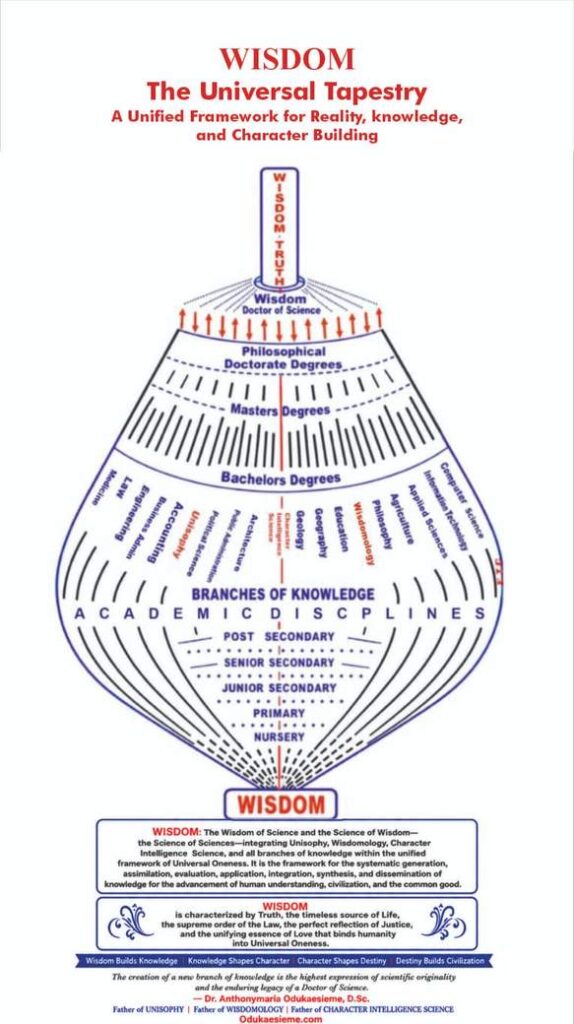
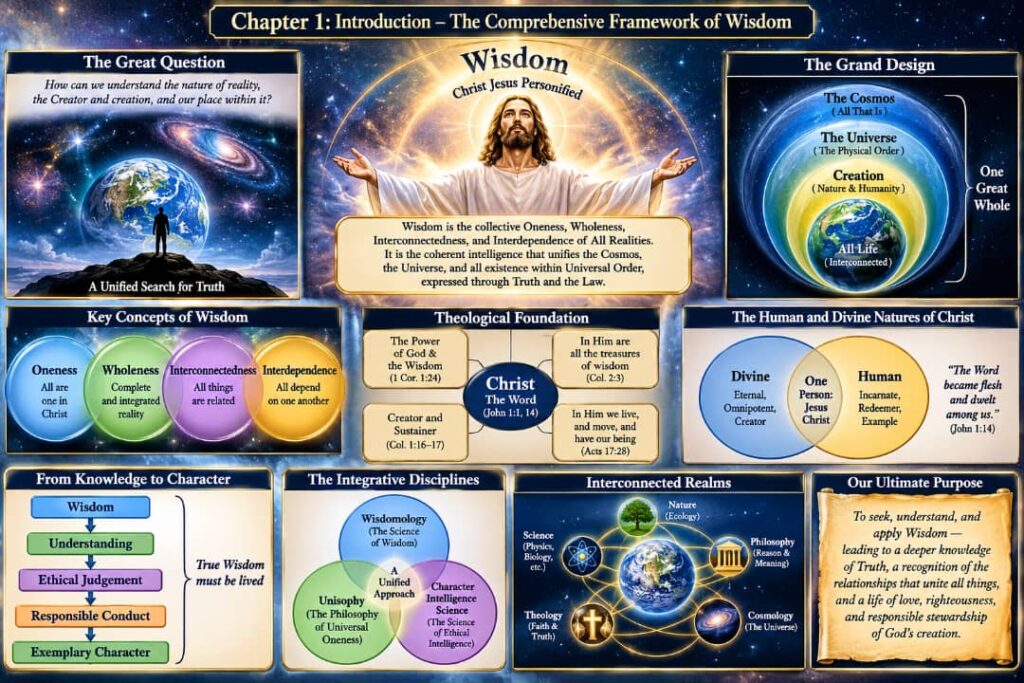
This is consistent with the central definition of Wisdom developed in this work as Oneness, Wholeness, Interconnectedness, and Interdependence within Universal Order.
8.19 THEOLOGICAL SIGNIFICANCE OF ABIDING
Abiding in Christ is more than occasional religious devotion.
It signifies a continuing orientation of life.
The disciple is called to remain in Christ’s teaching, love, commandments, and fellowship.
This has implications for daily conduct.
Wisdom must therefore enter ordinary life.
It must influence speech.
It must influence relationships.
It must influence work.
It must influence leadership.
It must influence treatment of the poor and vulnerable.
It must influence stewardship of creation.
It must influence the use of knowledge.
It must influence the exercise of power.
It must influence personal character.
A Wisdom that remains confined to theory has not fulfilled its practical purpose.
The branch exists to bear fruit.
8.20 CONCLUSION
The teaching of Christ as the Vine and believers as the branches presents one of the most profound relational images in Christian Scripture.
Jesus identifies Himself as the true Vine, the Father as the husbandman, and His disciples as branches. The image communicates dependence, relationship, continuity, cultivation, obedience, fruitfulness, and responsibility.
The central command is to abide.
The disciple is called to remain in Christ, and this abiding is inseparable from love and obedience. The purpose of abiding is fruitfulness.
The image also provides an important framework for understanding character. Genuine spiritual connection should produce visible ethical fruit. Love, joy, peace, patience, goodness, faithfulness, gentleness, and self-control are therefore relevant expressions of the transformed life.
At the same time, the metaphor must be interpreted responsibly. Christ is not literally a botanical vine, and believers are not literally branches in a biological sense. The image is theological and relational. It communicates spiritual dependence and fruitfulness through an organic analogy.
The metaphor also preserves distinction. The Father remains the Father, Christ remains the Vine, and believers remain the branches. Relationship does not require the destruction of identity.
This principle is important for the wider concept of Universal Oneness developed in this treatise. Oneness should not be confused with uniformity. Interconnectedness does not mean that every reality is identical. Interdependence does not erase distinction.
The Vine and branches therefore provide a profound illustration of Wisdom as relational understanding.
The branch finds its purpose in relationship to the vine.
The disciple finds spiritual fruitfulness in abiding in Christ.
Human beings find ethical significance in rightly understanding their relationship with God, one another, and creation.
Wisdom, therefore, is not merely the possession of knowledge.
It is the proper ordering of knowledge, relationship, character, responsibility, and existence within Truth and Universal Order.
The teaching of Christ the Vine consequently strengthens the central argument of this treatise: Wisdom is not fragmentation but integration; not isolation but relationship; not mere knowledge but knowledge ordered toward Truth, character, fruitfulness, and responsible living.
REFERENCES
The Holy Bible, King James Version.
Bauckham, R. (2008). Jesus and the God of Israel: God Crucified and Other Studies on the New Testament’s Christology of Divine Identity. Eerdmans.
Carson, D. A. (1991). The Gospel According to John. Eerdmans.
Hoskyns, E. C. (1947). The Fourth Gospel. Faber and Faber.
Koester, C. R. (2008). Symbolism in the Fourth Gospel: Meaning, Mystery, Community (2nd ed.). Fortress Press.
Morris, L. (1995). The Gospel According to John. Eerdmans.
Ridderbos, H. (1997). The Gospel of John: A Theological Commentary. Eerdmans.
Wright, N. T. (2013). Paul and the Faithfulness of God. Fortress Press.
DEFINITION OF WISDOM
Wisdom is the collective Oneness, Wholeness, Interconnectedness, and Interdependence of All Realities. It is the coherent intelligence that unifies Creation, the Cosmos, the Universe, and all existence within Universal Order, expressed through Truth and the Law established by the Creator.
— Odukaesieme
www.odukaesieme.com