

PREFACE
Truth is one of the most fundamental realities of human existence. Every human search for knowledge, wisdom, justice, meaning, faith, science, and civilization ultimately leads to the question of Truth.
Yet Truth is often approached in fragments. What is known may be separated from what is unknown; revealed Truth from unrevealed Truth; divine Truth from scientific Truth; philosophical Truth from practical Truth. This fragmentation limits humanity’s ability to perceive Truth in its fullness.
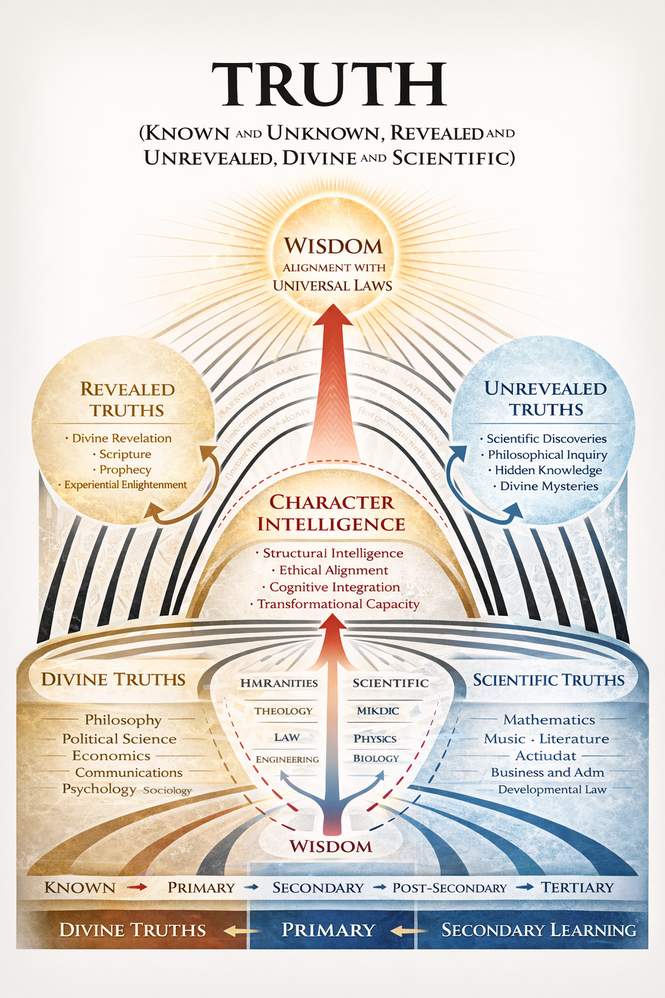
THE WHOLE TRUTH presents Truth as a unified reality whose dimensions may be discovered progressively through human inquiry, divine revelation, scientific investigation, wisdom, experience, and character.
This work explores the known and unknown, the revealed and unrevealed, the divine and scientific dimensions of Truth. It examines the laws governing Truth, the barriers that prevent its realization, and the process through which humanity can move from information and knowledge toward Wisdom.
At the heart of this work is a fundamental proposition: Truth does not exist merely to be known. Truth exists to transform the human being and to establish right relationship with the laws of existence.
Wisdom therefore becomes the synthesis through which Truth is properly understood, while Character Intelligence becomes its practical expression in human life.
THE WHOLE TRUTH is ultimately a call to move beyond fragmented knowledge toward an integrated understanding of reality—an understanding capable of contributing to human transformation, Universal Oneness, and a better civilization.
1. INTRODUCTION
Humanity has always searched for Truth.
From the earliest philosophical inquiries to modern scientific investigations, from religious revelation to personal experience, the search for Truth has remained one of the deepest motivations of human civilization.
Truth is not merely a collection of facts. It is the correspondence between reality and what is understood about reality.
The challenge is that human beings do not perceive all reality at once. Some Truths are known; others remain unknown. Some are revealed; others remain unrevealed. Some are accessible through scientific investigation, while others belong to dimensions of existence that transcend ordinary scientific measurement.
Therefore, the pursuit of Truth requires humility.
The unknown should not automatically be declared nonexistent simply because it has not yet been discovered. Likewise, what is claimed to be revealed should not be accepted without discernment.
The pursuit of Truth requires knowledge, inquiry, revelation, reason, wisdom, and character.
THE WHOLE TRUTH therefore represents not merely the possession of information, but the continuous movement of the human mind and spirit toward a fuller realization of reality.
2. THE NATURE OF TRUTH
Truth is what corresponds with reality.
It is not created by human opinion, political authority, cultural preference, or popular consensus.
Human beings may disagree about Truth, misunderstand it, conceal it, or discover it progressively, but disagreement does not necessarily alter Truth itself.
Truth possesses an objective dimension.
However, human perception of Truth may be limited by education, culture, experience, language, intelligence, prejudice, emotion, and character.
This distinction is essential:
Truth may be absolute, while human understanding of Truth may be progressive.
Therefore, intellectual humility is indispensable to the search for Truth.
The wise person does not confuse what is presently known with all that exists.
Truth is greater than human knowledge of Truth.
3. REVEALED TRUTHS
Revealed Truth refers to Truth made known through revelation.
Within religious traditions, revelation may be understood as divine communication concerning God, creation, morality, human purpose, salvation, and the ultimate destiny of humanity.
Revealed Truth occupies a distinctive place because it addresses questions that may transcend the capacity of ordinary empirical investigation.
However, the human interpretation of revelation remains subject to understanding, language, history, culture, and character.
Therefore, revelation requires discernment.
The pursuit of revealed Truth should not destroy reason; rather, reason should contribute to the responsible understanding of revelation.
Truth cannot contradict Truth.
Where genuine Truth is discovered, its dimensions should ultimately converge.
4. UNREVEALED TRUTHS
Not everything that is true has been discovered.
The unknown represents one of the greatest frontiers of human existence.
There are realities about nature, consciousness, the universe, life, human potential, and existence that humanity may not yet understand.
The fact that something is unknown does not make it untrue.
It simply means that its Truth has not yet been adequately realized.
Therefore, humanity must distinguish between:
What is false;
What is unknown;
What is unknowable;
And what is not yet discovered.
This distinction protects intellectual inquiry from both arrogance and premature certainty.
The unknown should inspire investigation rather than fear.
5. DIVINE TRUTHS
Divine Truth concerns realities associated with God, divine purpose, creation, morality, and the ultimate order of existence.
For the religious mind, divine Truth provides a foundation for understanding the meaning and purpose of life.
Divine Truth also raises profound questions:
Why does existence exist?
What is the ultimate source of reality?
What is the purpose of humanity?
What is the relationship between Creator and creation?
What is the ultimate destiny of the human person?
Such questions transcend ordinary material measurement.
Yet the search for divine Truth should encourage wisdom, humility, compassion, justice, responsibility, and character.
Truth that does not transform character remains incompletely realized in human life.
6. SCIENTIFIC TRUTHS
Scientific Truth emerges through observation, experimentation, evidence, reasoning, verification, and continuous inquiry.
Science has transformed humanity’s understanding of the natural world.
Scientific Truth is strengthened by evidence and remains open to refinement when better evidence becomes available.
Scientific inquiry therefore demonstrates an important principle of Truth:
Human understanding can evolve.
A scientific explanation may become more accurate as knowledge expands.
This does not diminish Truth; it demonstrates the progressive nature of human discovery.
Though evolving in expression, scientific truths reflect the underlying order established by divine law.
7. THE LEVELS OF TRUTH PERCEPTION
Human beings perceive Truth at different levels.
One person may perceive Truth through experience.
Another may perceive it through education.
Another through philosophical reflection.
Another through scientific investigation.
Another through spiritual revelation.
Another through Wisdom.
These different levels do not necessarily represent contradictory realities. They may represent different degrees or dimensions of perception.
The deeper challenge is to move from fragmented perception toward integrated understanding.
Knowledge gathers information.
Understanding connects information.
Wisdom places understanding in its proper relationship to life.
Character demonstrates that understanding through action.
Thus, the realization of Truth is not complete when Truth is merely intellectually recognized.
8. THE LAWS GOVERNING TRUTH
Truth operates within order.
Reality is not governed by human preference. Existence follows laws and principles whether or not humanity understands them.
Scientific laws reveal patterns within the natural world.
Moral laws reveal principles governing human conduct.
Universal laws reveal relationships extending beyond individual existence.
Divine law establishes ultimate order from the perspective of faith.
The human task is not to create reality but to discover, understand, respect, and align with the laws governing reality.
Wisdom is therefore the ability to recognize Truth and place oneself in proper relationship with it.
9. BARRIERS TO THE REALIZATION OF TRUTH
Many forces prevent humanity from realizing Truth.
Among them are:
Ignorance.
Pride.
Fear.
Prejudice.
Dishonesty.
Political manipulation.
Religious extremism.
Intellectual arrogance.
Cultural conditioning.
Self-interest.
Corruption.
Unexamined assumptions.
The greatest barrier may not be lack of information, but unwillingness to accept Truth when it challenges personal interest.
Truth requires courage.
It requires the willingness to examine what we believe, why we believe it, and whether our beliefs correspond with reality.
A civilization that fears Truth cannot achieve lasting progress.
10. THE PROCESS OF TRUTH REALIZATION
Truth realization is a process.
It begins with observation and inquiry.
It develops through learning, questioning, investigation, reflection, experience, and discernment.
It deepens through Wisdom.
And it becomes meaningful through character and action.
The process may therefore be expressed as:
Seek → Discover → Understand → Apply → Become.
The goal is not simply to know Truth but to live according to Truth.
The greatest realization of Truth occurs when what a person knows becomes what the person does and ultimately becomes who the person is.
11. WISDOM: THE SYNTHESIS OF TRUTH
Wisdom is the proper synthesis and application of Truth.
Knowledge may tell us what exists.
Truth tells us what corresponds with reality.
Wisdom determines how Truth should be understood, integrated, and applied for the good of life.
Wisdom therefore occupies a unique position in the realization of Truth.
It brings together knowledge, understanding, experience, discernment, morality, and action.
Through Wisdom, apparently separate dimensions of Truth can be examined in relationship with one another.
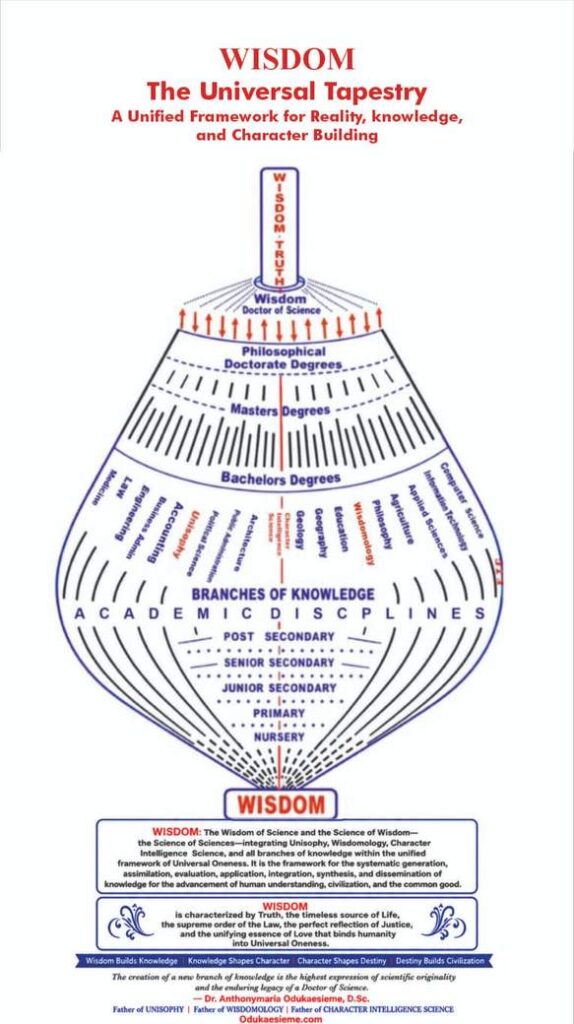
Science, philosophy, theology, education, and human experience can therefore become complementary instruments in the larger pursuit of Truth.
Wisdom unifies what fragmented knowledge separates.
12. CHARACTER INTELLIGENCE: THE EXPRESSION OF TRUTH
Truth must ultimately be expressed through character.
A person may possess knowledge without wisdom.
A person may possess intelligence without integrity.
A person may possess education without virtue.
Character Intelligence establishes the principle that the true value of human intelligence is demonstrated by how it is used.
Truth therefore demands character.
Honesty enables Truth to be spoken.
Humility enables Truth to be received.
Responsibility enables Truth to be applied.
Justice enables Truth to guide relationships.
Compassion enables Truth to serve humanity.
Character becomes the living expression of what the mind has discovered.
Knowledge without character can become dangerous.
Intelligence guided by character becomes beneficial to humanity.
13. INTERDISCIPLINARY UNITY OF TRUTH
Truth cannot be permanently confined within academic boundaries.
Science investigates nature.
Philosophy investigates meaning, reason, and existence.
Theology investigates divine realities.
Education develops human understanding.
Ethics examines right conduct.
Medicine investigates health and disease.
Technology applies knowledge to practical problems.
Yet all these disciplines ultimately participate in the human search for Truth.
The fragmentation of knowledge has produced enormous specialization, but humanity now needs integration.
The future requires a civilization capable of unifying knowledge in Wisdom.
The purpose is not to eliminate disciplines but to place them in proper relationship with one another.
Truth is one reality, even when approached through many disciplines.
14. DAILY PRACTICE OF TRUTH
Truth must become practical.
It should influence how people speak, think, work, govern, educate, worship, conduct business, conduct research, raise families, and relate with one another.
To practice Truth is to reject deliberate falsehood.
It is to acknowledge mistakes.
It is to seek evidence.
It is to listen before judging.
It is to act with integrity.
It is to respect human dignity.
It is to choose justice over corruption.
It is to choose responsibility over selfishness.
It is to allow Wisdom to guide intelligence.
A civilization becomes truthful not merely because its people know Truth, but because they practice it.
15. ALIGNMENT WITH ETERNAL AND UNIVERSAL LAWS
The ultimate purpose of Truth realization is alignment.
Human beings flourish when their lives are aligned with reality, moral order, universal principles, and divine purpose.
Misalignment produces disorder.
Alignment produces harmony.
The search for Truth therefore becomes a search for proper place.
Everything must ultimately return to its proper relationship within the order of existence.
Wisdom enables this alignment.
Universal Oneness provides the vision of interconnected existence.
Character provides the discipline required to live according to that vision.
Truth therefore becomes not merely something to discover but something with which life must be aligned.
16. THE LIVING TRUTH
The highest expression of Truth is a life transformed by Truth.
Truth becomes living when it enters thought, character, relationships, institutions, leadership, education, science, religion, and civilization.
A truthful person becomes an instrument of Truth.
A truthful institution becomes an instrument of justice.
A truthful educational system becomes an instrument of human transformation.
A truthful civilization becomes an instrument of peace and human flourishing.
The ultimate question is therefore not only:
“What is Truth?”
It is also:
“What does Truth require me to become?”
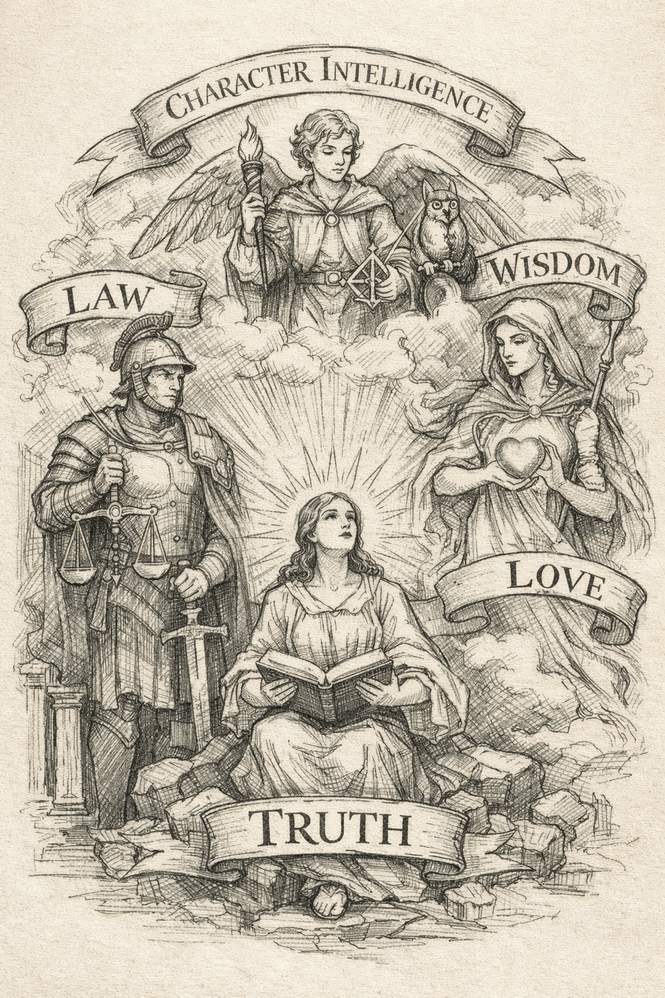
This is where Truth, Wisdom, and Character converge.
Truth reveals.
Wisdom interprets.
Character expresses.
And civilization becomes transformed.
17. CONCLUSION
THE WHOLE TRUTH is a journey from fragmented perception toward integrated realization.
The known must remain open to the unknown.
The revealed must be approached with discernment.
The scientific must be integrated with the philosophical.
The philosophical must remain open to the divine.
Knowledge must be guided by Wisdom.
Wisdom must be expressed through Character.
Character must serve humanity.
And humanity must recognize its place within the greater unity of existence.
The ultimate purpose of the search for Truth is not intellectual possession.
It is transformation.
Truth should make humanity wiser.
Wisdom should make humanity better.
Character should make humanity trustworthy.
And the integration of Truth, Wisdom, and Character should contribute to a civilization founded upon justice, responsibility, Universal Oneness, peace, and enduring human dignity.
The Whole Truth is therefore not merely everything that can be known.
It is the continuing realization of reality in its known and unknown, revealed and unrevealed, divine and scientific dimensions—and the progressive alignment of human life with what is true.
“In Truth, the mind discovers; in Wisdom, the soul aligns; in Character, the human becomes the living expression of eternal law.”
Dr. Anthonymaria Odukaesieme, D.Sc.
Founder and Father of Wisdomology, Unisophy, and Character Intelligence Science